
Social Value
Contents
What is Social Value?
Social value is the wider benefit that organisations create for people, communities, and the environment through what they do - beyond just financial value.
The Public Services (Social Value) Act (2012) requires all statutory sector organisations and their suppliers to consider how the services they commission and procure can improve the economic, social and environmental wellbeing of an area.
Why does it matter to my VCSE organisation?
Social Value affects VCSE organisations in two ways: -
When charities bid for statutory sector contracts and commissions, they are increasingly being asked to show that their offer creates real benefits for communities.
These questions are about accountability and understanding the wider impact of their investment. Being able to explain your social value clearly:
· Builds stronger partnerships
· Supports long-term sustainability
· Helps trustees understand impact and
· Can also strengthen funding applications
And it helps your organisation tell its story with confidence.
2. For-profit organisations delivering statutory sector contracts are increasingly looking to partner with VCSE organisations to meet their social value requirements. This might be through providing pro bono services to charities (such as legal or HR advice), or taking a more hands-on appriach through Employer Supported Volunteering (ESV). Locally Gloucestershire County Council has partnered with whatimpact to provide a brokerage service between businesses and VCSE organisations.
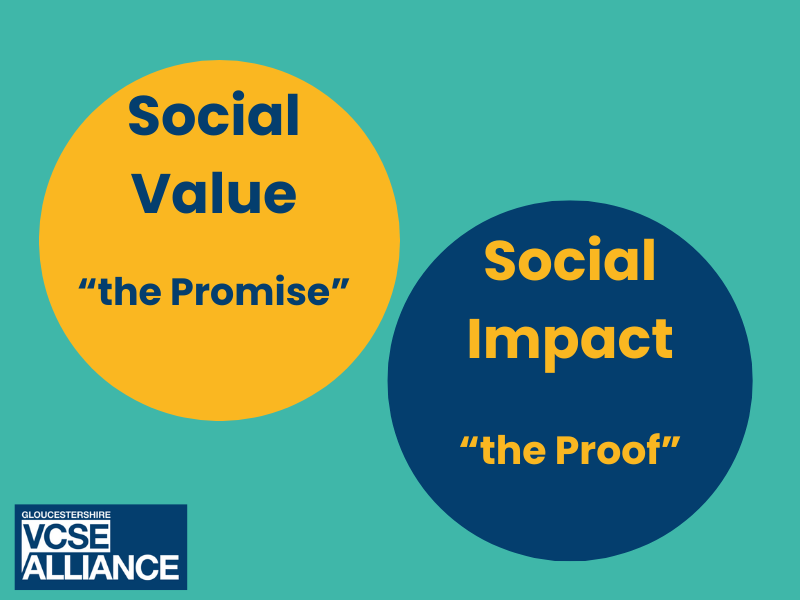
What’s the difference between Social Value and Social Impact?
There’s often confusion between Social Value and Social Impact, and an easy way
to differentiate between the two is this:
Social VALUE = “the PROMISE”
Social IMPACT = “the PROOF”
Resources
Useful Information for Gloucestershire


Gloucestershire County Council (GCC) has a designated Social Value webpage: Social Value | Gloucestershire County Council
GCC has also published a “Social Value Toolkit” aimed primarily at bidders and suppliers, but useful for any organisation with an interest in responsible business and sustainability: gloucestershire county council SOCIAL VALUE TOOLKIT
whatimpact is a social value marketplace. Gloucestershire County Council has partnered with whatimpact’s National Social Value Marketplace to help Council suppliers match with local voluntary, community and social enterprise organisations (VCSEs).
The platform makes it easier for suppliers to design contract-specific social value plans that are practical, measurable and relevant to the needs of Gloucestershire.
The platform enables suppliers to work with VCSE organisations to draw up locally relevant, contract specific social value plans that meet tender criteria. Their website is here: whatimpact | Social Value Management| Measure Social Value
Social Value Series
In this series of articles, Social Value expert, Janette Vizard (Grants and Social Value Officer at Bromford and our Treasurer) shares her knowledge and insights on Social Value for VCSE organisations.
Article 1: What do we Mean by Social Value, and Why It Matters (January 2026)
Article 2: From Activities to Impact: Understanding Outcomes and Social Value (February 2026)